


What is an OKR? Definition, Meaning, and Examples [2026 Guide]
![What is an OKR? Definition, Meaning, and Examples [2026 Guide]](/_next/image?url=https%3A%2F%2Fs3.nl-ams.scw.cloud%2Fannualplan%2Fuploads%2Fpreviews%2F6491988b47c73a3536a637c7c750ac14.png&w=3840&q=75)
OKR stands for Objectives and Key Results - a goal-setting framework used by Google, Intel & top companies. Learn OKR meaning, examples, and how to write effective OKRs.
AnnualPlan Team
Editorial
More in Okr
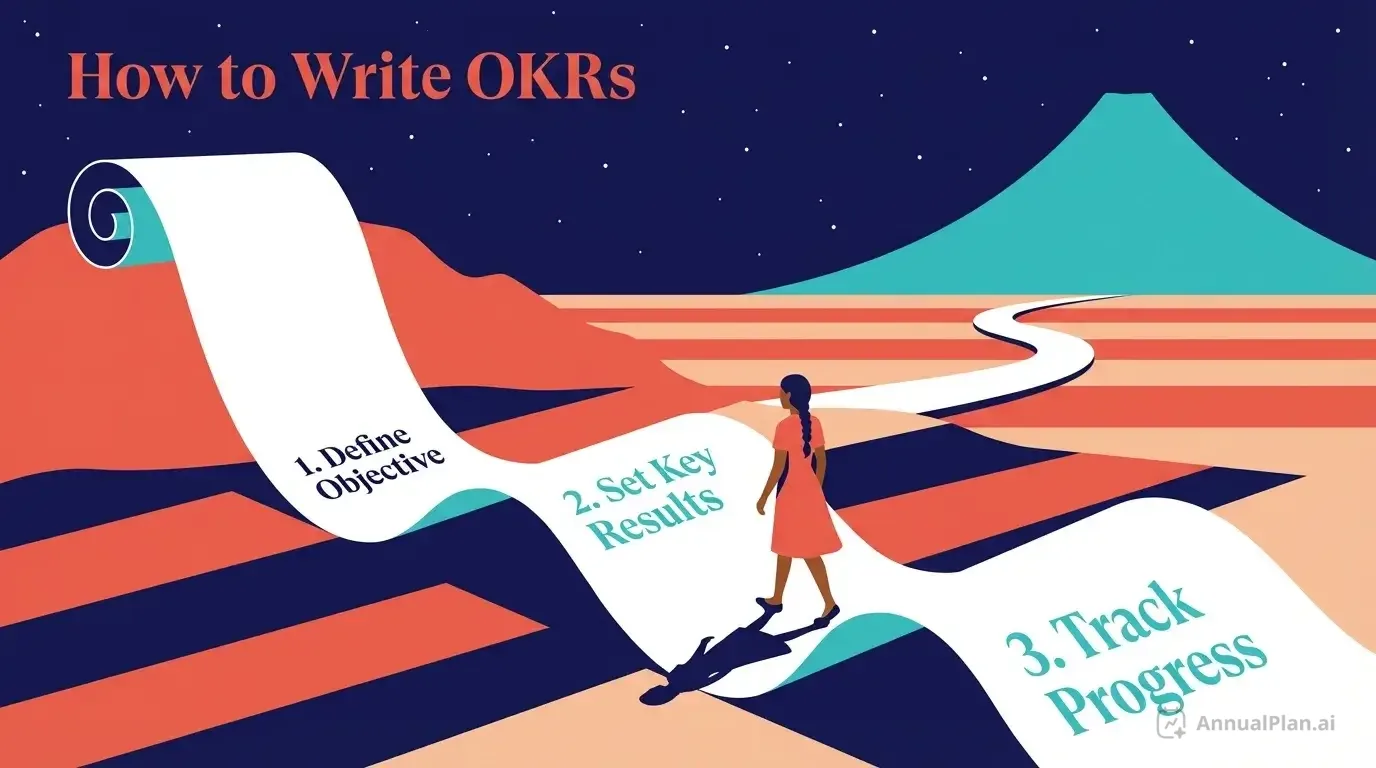
Table of Contents
Reading time: 15 minutes | Last updated: February 2026
OKR stands for Objectives and Key Results - a goal-setting framework used by individuals, teams, and organizations to define measurable goals and track their outcomes. An OKR consists of an Objective (a qualitative, inspirational goal describing what you want to achieve) paired with 3-5 Key Results (quantitative metrics that measure success). Originally developed by Andy Grove at Intel in the 1970s and later introduced to Google by John Doerr in 1999, OKRs have become the preferred methodology for high-growth companies seeking to create alignment, drive focus, and achieve ambitious goals.
Key Takeaways
- OKR meaning: Objectives and Key Results - a collaborative goal-setting methodology that connects ambitious goals with measurable outcomes
- The OKR formula: "I will [OBJECTIVE] as measured by [KEY RESULTS]"
- Success target: Achieving 60-70% of your OKRs indicates proper ambition; 100% achievement means goals weren't challenging enough
- Typical cadence: Quarterly cycles with weekly check-ins on progress
- Key difference from KPIs: OKRs drive change and improvement; KPIs monitor ongoing performance
Table of Contents
What Does OKR Stand For? {#what-does-okr-stand-for}
OKR stands for Objectives and Key Results. It is a goal-setting and leadership tool for communicating what you want to accomplish and the milestones you need to meet to accomplish it.
Think of OKRs like a GPS for your organization:
-
The Objective is your destination - where you want to go
-
The Key Results are the specific milestones that tell you you're on the right path
-
Initiatives (optional) are the routes you'll take to get there
This simple framework has been adopted by some of the world's leading organizations to set and enact their strategies, including Google, Intel, LinkedIn, Twitter, Spotify, and the Gates Foundation.
OKR Definition: Breaking Down the Components {#okr-definition}
What is an Objective?
An Objective is a significant, concrete, clearly defined goal that describes what you want to achieve. Objectives should be:
| Characteristic | Description | Example |
|---|---|---|
| Qualitative | Describes a desired state in words, not numbers | "Become the market leader in customer satisfaction" |
| Inspirational | Motivates the team and connects to purpose | "Create a world-class onboarding experience" |
| Ambitious | Stretches capabilities and encourages big thinking | "Crush the competition in our core market" |
| Time-bound | Has a clear deadline (typically quarterly) | "By end of Q2..." |
| Actionable | Something the team can actually influence | "Improve our product quality" (not "Change market conditions") |
What is a Key Result?
A Key Result is a measurable success criterion used to track the achievement of the objective. Key Results should be:
| Characteristic | Description | Example |
|---|---|---|
| Specific | Unambiguous and precisely defined | "Increase NPS from 35 to 55" (not "Improve customer happiness") |
| Measurable | Contains a number that can be tracked | "Achieve 99.9% uptime" |
| Outcome-focused | Measures results, not activities | "Generate 500 leads" (not "Send 10 email campaigns") |
| Challenging | Requires effort but remains achievable | Target 60-70% confidence at time of setting |
| Limited | 3-5 Key Results per Objective maximum | Fewer goals = greater focus |
The OKR Formula
The simplest way to understand OKRs is through John Doerr's famous formula:
"I will [OBJECTIVE] as measured by [KEY RESULTS]"
Example:
I will create a world-class customer onboarding experience as measured by:
-
Reducing time-to-value from 14 days to 3 days
-
Achieving 90% onboarding completion rate (up from 65%)
-
Reaching Net Promoter Score of 50+ for new customers
-
Decreasing support tickets from new users by 40%
A Brief History of OKRs: From Intel to Google {#okr-history}
The Origins: Peter Drucker and MBO (1954)
The foundation for OKRs was laid by Peter Drucker in his 1954 book "The Practice of Management," where he introduced Management by Objectives (MBO). This framework encouraged organizations to align individual goals with company objectives.
Andy Grove Creates OKRs at Intel (1970s)
Andy Grove, the legendary CEO of Intel, transformed Drucker's MBO framework into something more actionable. Grove's key insight was adding measurable Key Results to objectives - creating accountability that MBO lacked.
In his influential book "High Output Management" (1983), Grove described how objectives provide direction while key results provide measurable milestones. At Intel, OKRs helped the company navigate its famous pivot from memory chips to microprocessors.
Grove called his system "iMBOs" (Intel MBOs) before the term OKR became standard.
John Doerr Introduces OKRs to Google (1999)
John Doerr, a venture capitalist at Kleiner Perkins who learned OKRs while working at Intel under Andy Grove, introduced the framework to Google in 1999.
At the time, Google had just 40 employees. Doerr's presentation to Larry Page and Sergey Brin included this example:
Objective: Build a successful IPO
Key Results:
-
Reach $100M in revenue
-
Achieve 75% gross margins
-
Grow to 100,000 users
Google adopted OKRs immediately and has used them every quarter since. The company credits the methodology with helping scale from 40 employees to over 180,000 while maintaining strategic alignment.
"Measure What Matters" Goes Global (2018)
John Doerr's 2018 book "Measure What Matters: How Google, Bono, and the Gates Foundation Rock the World with OKRs" brought the methodology to a global audience. The bestseller included case studies from Intel, Google, the Gates Foundation, and Bono's ONE Campaign.
Today, organizations of all sizes use OKRs - from startups to Fortune 500 companies, from tech firms to nonprofits and government agencies.
How the OKR Framework Works {#how-okrs-work}
The OKR Hierarchy: Creating Alignment
OKRs create alignment by cascading from company strategy to individual contributors:
Company OKRs (3-5 objectives)

    ↓ supports

Department OKRs

    ↓ supports

Team OKRs

    ↓ supports

Individual OKRs (optional)
This hierarchy ensures everyone understands how their work connects to organizational strategy. A marketing coordinator writing blog posts can trace their work to content goals → demand generation objectives → company growth targets.
The Quarterly OKR Cycle
Most organizations follow a quarterly OKR rhythm:
Weeks 1-2: Planning
-
Leadership finalizes company OKRs
-
Departments and teams draft supporting OKRs
-
Cross-functional alignment discussions
-
OKRs published and shared transparently
Weeks 3-11: Execution
-
Weekly check-ins (15-30 minutes)
-
Update Key Result progress scores
-
Identify and clear blockers
-
Celebrate wins and course-correct
Week 12: Review
-
Final scoring of all Key Results (0-1.0 scale)
-
Retrospective on learnings
-
Begin planning next quarter
Transparency: A Core Principle
Unlike traditional goal-setting where goals are often private between employee and manager, OKRs are typically visible across the entire organization. This transparency:
-
Enables collaboration across teams
-
Reduces duplicate efforts
-
Creates accountability
-
Builds trust in leadership
-
Helps identify dependencies
At Google, any employee can see anyone else's OKRs - including the CEO's.
The F.A.C.T.S. of OKRs: Five Key Benefits {#okr-benefits}
OKRs provide five powerful benefits that John Doerr summarizes with the acronym F.A.C.T.S.:
F - Focus
With only 3-5 Objectives and 3-5 Key Results each, OKRs force ruthless prioritization. Teams must identify what matters most rather than spreading effort across dozens of goals.
"If everything is important, nothing is."
A - Alignment
When OKRs are transparent and cascaded, everyone understands how their work connects to company strategy. Research shows companies with highly aligned employees are more than twice as likely to be top performers.
C - Commitment
Public OKRs create commitment. When your goals are visible to peers and leadership, you're more likely to follow through. Weekly check-ins reinforce this commitment.
T - Tracking
Key Results with specific metrics create clear accountability. There's no ambiguity about whether goals were achieved. Teams can objectively assess progress weekly and course-correct as needed.
S - Stretching
OKRs embrace ambitious "stretch" goals. Unlike traditional goal-setting where 100% achievement is expected, OKRs target 60-70% achievement. This encourages teams to think bigger than they would otherwise.
Google's "moonshot" projects - self-driving cars, Chrome, Android - emerged from a culture of ambitious OKR setting.
Types of OKRs {#types-of-okrs}
Committed vs. Aspirational OKRs
Committed OKRs are goals the organization must achieve. Resources are allocated, and 100% completion is expected. Missing a committed OKR triggers review and corrective action.
Aspirational OKRs (also called "moonshots") are stretch goals that push boundaries. Achieving 60-70% is considered success. These OKRs drive innovation and big thinking.
Most organizations use a mix: ~60% committed, ~40% aspirational.
Top-Down vs. Bottom-Up OKRs
Top-Down OKRs cascade from leadership to teams. Company → Department → Team → Individual.
Bottom-Up OKRs emerge from teams and individuals based on their expertise and frontline insights.
Best practice is a blend: approximately 50% top-down (strategic direction) and 50% bottom-up (tactical expertise).
Build, Improve, and Innovate OKRs
Another useful classification:
| Type | Purpose | Example |
|---|---|---|
| Build | Create something new | "Launch mobile app for Android users" |
| Improve | Enhance existing capabilities | "Reduce page load time by 50%" |
| Innovate | Explore new opportunities | "Test 3 new market segments" |
Learning OKRs
Learning OKRs focus on discovery rather than achievement. They're useful when:
-
Entering a new market
-
Launching an experimental product
-
Testing assumptions before scaling
Example Learning OKR:
-
Objective: Understand customer pain points in enterprise segment
-
Key Results: Conduct 50 customer interviews; Document top 10 pain points; Identify 3 addressable opportunities
OKR Examples from Real Companies {#okr-examples}
Example 1: City of Syracuse, NY (Government)
Objective: Achieve fiscal sustainability for the City
Key Results:
-
Reduce budget variance from 5% to <1%
-
Increase capital spending efficiency by 20%
-
Improve bond rating from BBB to A
This example shows OKRs work beyond tech companies.
Example 2: Allbirds (Retail/Sustainability)
Objective: Create the world's first carbon-neutral footwear
Key Results:
-
Achieve carbon neutrality in 100% of manufacturing
-
Source 95% of materials from sustainable suppliers
-
Reduce packaging waste by 50%
-
Publish transparent carbon footprint for all products
Example 3: Google Chrome Launch
Objective: Build the best browser in the world
Key Results:
-
Reach 20 million weekly active users
-
Achieve fastest JavaScript performance (10x competitors)
-
Launch on Windows, Mac, and Linux within 6 months
Chrome surpassed these goals and now has billions of users.
Example 4: Marketing Team OKR
Objective: Build a demand generation engine that fuels predictable growth
Key Results:
-
Generate 5,000 marketing qualified leads (up from 2,800)
-
Achieve 30% MQL-to-SQL conversion rate (up from 22%)
-
Reduce customer acquisition cost from $180 to $120
-
Grow organic traffic from 150K to 300K monthly visits
Example 5: Engineering Team OKR
Objective: Deliver a fast, reliable platform that customers love
Key Results:
-
Improve application response time from 800ms to <200ms
-
Achieve 99.95% uptime (up from 99.5%)
-
Reduce critical production incidents by 60%
-
Increase deployment frequency from weekly to daily
How to Write Effective OKRs {#how-to-write-okrs}
Step 1: Start with Strategy
Before writing OKRs, clarify your strategic direction:
-
Where do we want to be in 3-5 years?
-
What are our key priorities this year?
-
What must be true for us to succeed?
OKRs should connect to this bigger picture.
Step 2: Draft 3-5 Objectives
For each quarter, identify 3-5 Objectives. Use this checklist:
-
Is it inspirational and ambitious?
-
Is it qualitative (not a metric)?
-
Can our team actually influence this outcome?
-
Does it align with company strategy?
-
Will achieving it meaningfully advance our mission?
Step 3: Define 3-5 Key Results per Objective
For each Objective, define 3-5 measurable Key Results:
-
Is it measurable with a specific number?
-
Does it measure an outcome (not an activity)?
-
Do we have 60-70% confidence we can achieve it?
-
If we achieve all Key Results, have we achieved the Objective?
Good OKR vs. Bad OKR Examples
| Bad OKR | Problem | Good OKR |
|---|---|---|
| O: Improve customer experience | Vague, not inspiring | O: Become the company customers recommend to friends |
| KR: Launch email campaign | Activity, not outcome | KR: Increase NPS from 35 to 55 |
| KR: Make customers happier | Not measurable | KR: Achieve 4.5/5 satisfaction score |
| KR: Hire more people | Doesn't indicate value | KR: Reduce response time from 4 hours to 15 minutes |
The "So What?" Test
For every Key Result, ask "So what?" If you can ask it, you're measuring an activity, not an outcome.
-
"Launch 5 email campaigns" → So what? → "Generate 2,000 qualified leads from email"
-
"Hire 3 engineers" → So what? → "Increase deployment velocity by 40%"
-
"Publish 20 blog posts" → So what? → "Grow organic traffic by 50%"
OKR Grading: How to Score Your Results {#okr-grading}
The 0-1.0 Scoring Scale
At the end of each cycle, score Key Results on a 0 to 1.0 scale:
| Score | Meaning | Interpretation |
|---|---|---|
| 0.0 - 0.3 | Red | Failed to make meaningful progress |
| 0.4 - 0.6 | Yellow | Made progress but fell significantly short |
| 0.7 - 0.8 | Green | Strong delivery - target zone |
| 0.9 - 1.0 | Blue | Exceptional - goals may have been too easy |
What's a "Good" Score?
0.6-0.7 (60-70%) is the sweet spot. This indicates ambitious goals with solid execution.
-
Consistently scoring 1.0? Your goals aren't ambitious enough. This is "sandbagging."
-
****Consistently scoring < 0.4? Goals may be too aggressive, or resources are misaligned.
Alternative Grading Methods
Red/Yellow/Green:
-
Red: Unlikely to achieve; needs intervention
-
Yellow: At risk; needs attention
-
Green: On track to achieve
Simple percentage: Calculate actual vs. target as a percentage.
OKRs vs KPIs: Understanding the Difference {#okr-vs-kpi}
One of the most common questions: "How are OKRs different from KPIs?"
Key Differences
| Factor | OKRs | KPIs |
|---|---|---|
| Purpose | Drive change and improvement | Monitor ongoing performance |
| Nature | Time-bound goals | Continuous metrics |
| Ambition | Stretch (60-70% achievement OK) | Target 100% |
| Focus | What to improve | What to monitor |
| Frequency | Quarterly cycles | Ongoing tracking |
The Dashboard Analogy
Think of driving a car:
-
KPIs are your dashboard: speed, fuel level, engine temperature. They tell you how the car is running.
-
OKRs are your destination and route: where you're going and the milestones along the way.
You need both. KPIs without OKRs means monitoring without direction. OKRs without KPIs means goals without context.
How They Work Together
KPI: Monthly churn rate (currently 5%)
OKR Objective: Dramatically improve customer retention
OKR Key Result: Reduce monthly churn from 5% to 2%
The KPI monitors the metric continuously. The OKR drives specific improvement initiatives.
Read our complete guide: OKR vs KPI →
Common OKR Mistakes to Avoid {#okr-mistakes}
1. Too Many OKRs
The Problem: Teams set 8-10 Objectives with 5+ Key Results each.
The Fix: Enforce 3-5 Objectives with 3-5 Key Results maximum. If everything is a priority, nothing is.
2. Key Results Without Numbers
The Problem: "Improve customer experience" or "Build better relationships."
The Fix: Every Key Result needs a specific number. "Achieve NPS of 55+" or "95% satisfaction rating."
3. Measuring Activities Instead of Outcomes
The Problem: "Launch 5 campaigns" instead of "Generate 2,000 leads."
The Fix: Apply the "So what?" test. Activities aren't valuable unless they produce outcomes.
4. Set It and Forget It
The Problem: Writing OKRs at quarter start and ignoring until quarter end.
The Fix: Weekly check-ins are essential. OKRs should guide daily priorities.
5. Sandbagging
The Problem: Setting conservative goals to guarantee success.
The Fix: If you consistently score 1.0, raise the bar. Target 60-70% achievement.
6. Treating OKRs as "Business as Usual"
The Problem: OKRs that describe ongoing work rather than meaningful change.
The Fix: OKRs should move the needle. If it's routine work, it's not an OKR.
7. Tying OKRs to Compensation
The Problem: When bonuses depend on OKR scores, people sandbag.
The Fix: Keep OKRs separate from performance reviews and bonuses.
8. No Alignment Discussion
The Problem: Teams create OKRs in isolation without coordination.
The Fix: Discuss dependencies and alignment with peer teams during OKR setting.
See our complete guide: 15 OKR Mistakes →
Getting Started with OKRs {#getting-started}
Week 1-2: Preparation
-
Educate leadership on OKR philosophy and methodology
-
Decide on scope: Start with one team or go company-wide?
-
Choose your cadence: Quarterly is recommended for most organizations
-
Assign an OKR champion to drive implementation
-
Select your tools: Spreadsheet for small teams; dedicated software for 20+ people
Week 3-4: Company OKRs
-
Leadership drafts 3-5 company Objectives
-
Define Key Results for each Objective
-
Share drafts for input from broader organization
-
Finalize and communicate company OKRs
Week 5-6: Team OKRs
-
Teams draft OKRs supporting company priorities
-
Cross-functional alignment discussions
-
Finalize and publish all team OKRs
-
Set up tracking system
Week 7+: Execute and Iterate
-
Weekly check-ins on progress
-
Monthly deeper reviews
-
Quarterly scoring and reflection
-
Continuous improvement each cycle
Expect the first quarter to be a learning experience. Most organizations see meaningful improvement by quarter 2-3.
Frequently Asked Questions {#faq}
What does OKR stand for?
OKR stands for Objectives and Key Results. It's a goal-setting framework that pairs ambitious qualitative goals (Objectives) with specific measurable outcomes (Key Results).
How many OKRs should I have?
3-5 Objectives with 3-5 Key Results each is the standard recommendation. This creates focus. More than this typically leads to diluted attention.
What is a good OKR score?
0.6-0.7 (60-70%) is the target range. Consistently scoring 1.0 means goals weren't ambitious enough. Consistently below 0.4 suggests goals may be too aggressive.
How often should OKRs be reviewed?
Weekly check-ins (15-30 minutes) to update progress. Monthly deep dives for strategic discussions. Quarterly scoring and new OKR setting.
Should OKRs be tied to compensation?
Generally no. When bonuses depend on OKR scores, people set conservative goals. Keep OKRs for strategic alignment; use other mechanisms for performance evaluation.
Who invented OKRs?
Andy Grove created OKRs at Intel in the 1970s. John Doerr introduced them to Google in 1999, where they became famous.
How are OKRs different from KPIs?
KPIs monitor ongoing performance metrics. OKRs drive specific change initiatives. They complement each other - use both.
Can individuals have OKRs?
Yes, but many organizations start with company and team OKRs before adding individual OKRs to avoid complexity overload.
How do OKRs work with Agile/Scrum?
OKRs set quarterly direction (why and what). Sprints execute the work (how). Sprint goals should ladder up to Key Results.
How long does it take to get good at OKRs?
Most organizations see meaningful improvement after 2-3 quarters. The first quarter is learning; by quarter three, the system feels natural.
Related Resources
OKR Deep-Dive Guides
OKR Examples
Recommended Books
-
"Measure What Matters" by John Doerr
-
"High Output Management" by Andy Grove
-
"Radical Focus" by Christina Wodtke
Start Setting Better Goals Today
OKRs have helped thousands of organizations - from startups to enterprises - achieve ambitious goals through focus, alignment, and accountability.
AnnualPlan.ai helps you implement OKRs with:
-
AI-powered OKR suggestions based on your role and industry
-
Automatic progress tracking with tool integrations
-
Alignment visualization from individual to company
-
Predictive insights on at-risk OKRs
Start Free Trial → | View OKR Templates →
This guide is part of AnnualPlan.ai's comprehensive resource library on strategic planning and goal-setting. For more guides, visit our OKR Resource Center.
About AnnualPlan Team
Content creator and writer at AnnualPlan.ai. Passionate about helping people achieve their goals through structured planning and consistent habits.