


How to Write OKRs: Guide
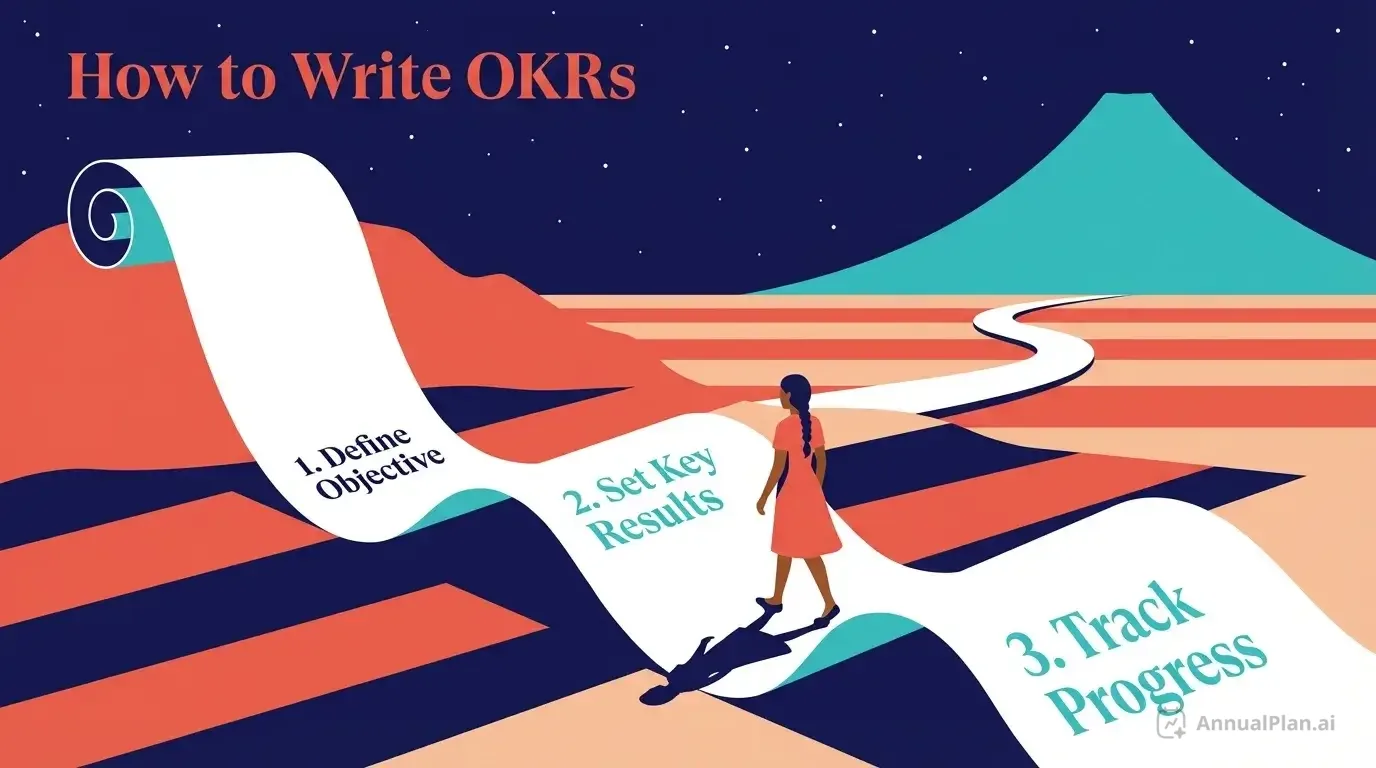
Simple 4-step guide to writing effective OKRs with formula and examples
AnnualPlan Team
Editorial
Table of Contents
How to Write OKRs: A Simple 4-Step Guide with Examples
Reading time: 5 minutes | Last updated: February 2026
Writing effective OKRs is simpler than most guides make it seem. Use this formula: "I will [OBJECTIVE] as measured by [KEY RESULTS]." The Objective describes what you want to achieve. The Key Results measure how you'll know you achieved it. This guide walks you through the process with examples.
Quick Summary
- Identify your top 3-5 priorities
- Write inspiring, qualitative Objectives
- Add 3-5 measurable Key Results per Objective
- Calibrate for stretch (aim for 60-70% confidence)
The OKR Formula
Every OKR follows this simple structure:
"I will [OBJECTIVE] as measured by [KEY RESULTS]"
Example:
- I will launch a world-class customer onboarding experience
- As measured by:
- Reduce time-to-value from 14 days to 3 days
- Achieve 90% onboarding completion rate
- Reach NPS of 50+ for new customers
Step 1: Identify Your Priorities
Before writing OKRs, answer: What are the 3-5 most important things we need to accomplish?
Don't try to OKR everything. OKRs are for your top priorities - the initiatives that will move the needle most.
Ask:
- What would make this quarter a success?
- What's blocking our biggest goals?
- Where should we focus limited resources?
Tip: If you have more than 5 Objectives, you haven't prioritized enough.
Step 2: Write Your Objectives
An Objective answers: "What do we want to achieve?"
Good Objectives are:
- Qualitative - Describes a destination, not a number
- Inspirational - Motivates the team
- Ambitious - Stretches capabilities
- Actionable - Something you can influence
- Time-bound - Has a deadline (usually quarterly)
Examples of Good Objectives:
- "Create the best onboarding experience in our industry"
- "Build a sales engine that delivers predictable growth"
- "Become the go-to resource for OKR best practices"
Examples of Bad Objectives:
- "Increase revenue by 25%" ← This is a Key Result, not an Objective
- "Do marketing stuff" ← Too vague
- "Maintain current performance" ← Not ambitious
Step 3: Write Your Key Results
Key Results answer: "How will we know we achieved the Objective?"
Good Key Results are:
- Specific - Unambiguous and clear
- Measurable - Contains a number
- Outcome-focused - Measures results, not activities
- Challenging - Requires effort to achieve
The "So What?" Test:
For each Key Result, ask "So what?" If you can ask it, you're measuring an activity, not an outcome.
| Activity (Bad) | Outcome (Good) |
|---|---|
| Launch 5 email campaigns | Generate 500 qualified leads from email |
| Publish 20 blog posts | Grow organic traffic by 50% |
| Conduct 10 customer interviews | Identify 3 validated product opportunities |
3-5 per Objective. Fewer loses important dimensions; more dilutes focus.
Step 4: Calibrate for Stretch
OKRs should be ambitious. Target 60-70% confidence when you set them.
- Too easy: "I'm 90% sure we'll hit this" → Raise the bar
- Just right: "I'm 60-70% sure we'll hit this" → Good stretch
- Too hard: "I'm 20% sure we'll hit this" → May demotivate
Remember: Achieving 70% of an OKR is success, not failure. If you consistently hit 100%, your goals aren't ambitious enough.
Complete OKR Examples
Marketing OKR
Objective: Build a demand generation engine that fuels predictable growth
Key Results:
- Generate 5,000 marketing qualified leads (up from 2,800)
- Achieve 30% MQL-to-SQL conversion rate (up from 22%)
- Reduce customer acquisition cost from $180 to $120
- Grow organic traffic from 150K to 300K monthly visits
Sales OKR
Objective: Create a world-class sales experience that wins enterprise deals
Key Results:
- Close $3.5M in new annual recurring revenue
- Achieve 115% quota attainment across the team
- Reduce average sales cycle from 60 to 40 days
- Increase average deal size from $25K to $40K
Product OKR
Objective: Deliver a product that customers can't live without
Key Results:
- Achieve 75% feature adoption within 30 days of launch
- Improve user activation rate from 45% to 65%
- Reduce support tickets by 40%
- Reach user satisfaction score of 4.5/5
Personal OKR
Objective: Complete my first marathon this year
Key Results:
- Run 4 times per week for 16 weeks
- Complete a half-marathon by month 3
- Achieve sub-4:30 marathon time
- Zero injuries requiring medical attention
Common Mistakes to Avoid
1. Too many OKRs
Stick to 3-5 Objectives with 3-5 Key Results each. More = less focus.
2. Key Results without numbers
"Improve customer experience" isn't measurable. "Achieve NPS of 55+" is.
3. Measuring activities instead of outcomes
"Launch product" is an activity. "Acquire 1,000 users" is an outcome.
4. Setting it and forgetting it
Review OKRs weekly. They should guide daily priorities.
5. Expecting 100% achievement
If you consistently hit all OKRs, raise the bar. 70% is the target.
OKR Writing Checklist
Before finalizing, verify each OKR:
Objective:
- Qualitative (not a number)?
- Inspirational and ambitious?
- Something we can influence?
- Aligned with company strategy?
Key Results:
- Measurable with a specific number?
- Outcome-focused (passes "So what?" test)?
- 60-70% confidence we can achieve?
- 3-5 Key Results per Objective?
Summary
Writing OKRs is straightforward:
- Prioritize - Focus on 3-5 things that matter most
- Write Objectives - Inspiring, qualitative goals
- Add Key Results - Measurable outcomes (not activities)
- Calibrate - Aim for 60-70% confidence
Use the formula: "I will [Objective] as measured by [Key Results]"
Related Resources
About AnnualPlan Team
Content creator and writer at AnnualPlan.ai. Passionate about helping people achieve their goals through structured planning and consistent habits.
![What is an OKR? Definition, Meaning, and Examples [2026 Guide]](/_next/image?url=https%3A%2F%2Fs3.nl-ams.scw.cloud%2Fannualplan%2Fuploads%2Fpreviews%2F6491988b47c73a3536a637c7c750ac14.png&w=3840&q=75)